


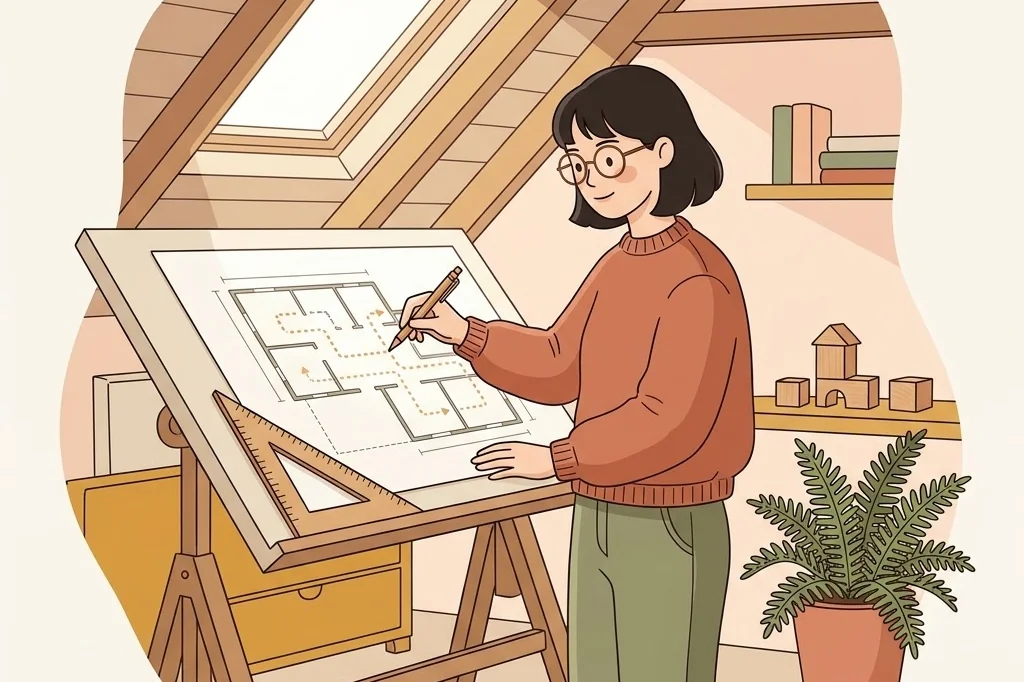
Human memory evolved for survival across physical landscapes, not for memorizing abstract bullet points on a screen. For thousands of years, ancient orators used spatial navigation to deliver hours of complex speeches without notes. This cognitive framework, known as the method of loci memory palace, leverages your brain’s natural spatial mapping hardware to store and recall vast amounts of structured information.
Instead of relying on brute repetition, you anchor concepts to fixed physical coordinates inside a familiar building. When you need to retrieve the data, you simply take a mental walk through that space. By grounding abstract ideas in physical geography, you reduce cognitive friction and build an organized mental vault. At EZ Upskill, we focus on engineering deliberate cognitive systems that turn high-volume learning into a repeatable, systematic discipline.
Key Takeaways
A structured summary of architectural memory palace construction:
- The method of loci exploits hippocampal place cells and grid cells to encode information into spatial environments.
- Begin with a space you know intimately, such as your childhood home or current residence, rather than an imaginary structure.
- Establish a strict, non-intersecting clockwise route through your palace to preserve the sequence of your data.
- Select distinct, static micro-locations (loci) that do not blend into each other or create perceptual ambiguity.
- Pair clear spatial waypoints with vivid, multisensory associations to guarantee rapid and durable retrieval.
The Neurobiology of Spatial Cognition
Why does the human brain remember a childhood bedroom effortlessly while struggling to recall a six-digit code after ten minutes? The answer lies in evolutionary neurology. Millions of years of hominid survival required remembering where food was located, which paths concealed predators, and how to return home across complex terrain. Our survival depended on spatial orientation.
Neuroscientists have demonstrated that the hippocampus contains specialized neurons known as place cells and grid cells. Place cells fire when an organism enters a specific location in an environment, while grid cells create an internal triangular coordinate system. Clinical neuroimaging studies published in neuroscience research journals show that mnemonic athletes possess brain networks functionally reorganized through spatial training. They do not have larger brains or higher baseline IQ scores; they simply recruit spatial networks when storing non-spatial data.
When you transform facts into spatial anchors, you offload processing demands from your prefrontal cortex to your visual and spatial processing centers. This strategic division of labor helps in managing cognitive load when learning, allowing you to absorb complex technical domains without feeling overwhelmed by sheer volume.
Selecting Your First Architectural Base
The most common failure point for beginners is building an imaginary palace from scratch. Creating fictional architecture forces your working memory to generate room dimensions, textures, and lighting while simultaneously attempting to store data. This dual burden causes immediate mental fatigue.
For your initial palace, select a real-world building that you can visualize with your eyes closed. Your current apartment, your childhood house, your high school library, or your daily gym provide ideal foundations. You already possess thousands of hours of tactile, visual, and spatial experience in these spaces. The neurological wiring already exists; you only need to use it as a storage shelf.
Ensure the chosen environment meets three core criteria:
- High Spatial Familiarity: You can navigate every room in the dark without bumping into furniture.
- Distinct Visual Boundaries: Rooms must have clear architectural transitions, such as distinct doorways, flooring shifts, or lighting contrasts.
- Static Features: Do not use transient items like laundry piles, seasonal decorations, or movable chairs as permanent storage loci.
Engineering the Traversal Route and Loci Spacing
Once you select your environment, you must map a precise, sequential path through it. Without a standardized traversal path, your memory palace becomes an unorganized attic where items are easily misplaced or skipped. In cognitive science, disciplined path design is the bedrock of rapid retrieval.
Follow a strict clockwise progression around each room. Enter the room from the primary doorway, turn left, and move along the perimeter until you return to the exit. For advanced insights on preventing path interference and bottlenecks, explore our detailed guide on memory palace route design. Establish five distinct loci per room to maintain consistent density:
- Locus 1 (Entry point): The main doorway, threshold, or coat rack directly inside the entrance.
- Locus 2 (First corner): The front-left corner, occupied by a floor lamp or low bookshelf.
- Locus 3 (Primary wall feature): The large study desk or credenza along the left wall.
- Locus 4 (Second corner): The far-left window frame or armchair.
- Locus 5 (Room center): The coffee table or central rug before transitioning to the next space.
By standardizing five loci per room across four rooms, you construct a dependable twenty-station palace. Keep all loci roughly eye-level or waist-level. Looking too high into ceiling corners or too low into floor registers creates visual strain and disrupts your mental flow.
Encoding Your First Practice Dataset
Now that your twenty stations are calibrated, test the architecture with a practical dataset. Avoid starting with raw abstract formulas; begin with a sequential historical timeline, a scientific taxonomy, or key tenets of cognitive psychology. If your ultimate goal is encoding computer science algorithms or intricate data models, read our tactical framework for memory palace for complex data.
Follow the three-step encoding protocol at each waypoint:
1. Concrete Object Conversion
Translate the target data point into a physical, tangible object. If you are memorizing the concept of biological homeostasis, imagine an antique brass thermostat vibrating violently with steam escaping from its vents. Tangible objects interact with spatial surfaces far more effectively than floating words.
2. Physical Anchor Interaction
Do not simply place the object on top of the locus like a passive ornament. Make the object interact with the locus physically. Smash the steaming thermostat directly through the wooden surface of your study desk, sending splinters across the rug. Physical interactions trigger motor and tactile sensory processing.
3. Multisensory Amplification
Engage multiple sensory modalities. Hear the loud hiss of the escaping steam, smell the burnt ozone and scorched timber, and feel the heat radiating against your face. The more sensory channels you activate simultaneously, the more retrieval cues your brain creates across its associative networks.
Retrieval Practice and Consolidation Protocols
Constructing a memory palace is only half the equation; structured retrieval locks the neural pathways into long-term memory. Once you deposit your twenty items, close your eyes and walk through the route sequentially from station 1 to station 20. Observe each scene without checking your reference notes.
Next, reverse the traversal direction. Walk backward from station 20 to station 1. Reversing the trajectory proves that your recall relies on spatial geometry rather than auditory phonetic loops. Finally, practice random-access jumping. Pick station 7, station 14, and station 3 at random and visualize what is happening at those precise coordinates. This rapid-jumping capability builds cognitive agility and guarantees swift retrieval under examination or real-world pressure.
Frequently Asked Questions
How many items can a single memory palace hold?
A typical residential apartment easily supports 20 to 50 distinct loci without feeling cramped. Advanced mnemonists combine multiple buildings, entire college campuses, and neighborhood walking routes to create master palace networks holding thousands of discrete data points.
Can I reuse the same memory palace for different subjects?
Yes, but you must distinguish between temporary scratchpad palaces and permanent vaults. Scratchpad palaces used for shopping lists or temporary presentations can be overwritten after a few days of mental rest. Permanent palaces used for core professional knowledge should remain dedicated to a single subject to avoid associative cross-contamination.
What if my real-world living space is too small?
You do not need a mansion to build an effective palace. You can use your workplace, favorite coffee shop, local library, or even a familiar park walking path. Every distinct physical location with clear visual landmarks can serve as a functional memory palace.
Why do some images fade quickly while others stick?
Images fade when they lack emotional intensity, physical interaction, or sensory distinctiveness. If you merely place a flat book on a table, your brain filters it out as visual noise. If that book explodes into blue flames and scorches the tablecloth, the unexpected novelty forces the hippocampus to flag it for permanent retention.
Building your first architectural memory palace transforms learning from an exhausting mental struggle into a structured, spatial navigation skill. Ground your information in familiar coordinates, establish strict traversal habits, and let your evolutionary hardware do the heavy lifting.